Annual Cost of Owning Property in Spain (2026)
The real yearly cost of owning a new-build in Spain in 2026: community fees, IBI, IRNR, utilities, insurance and the taxes you pay when you sell.
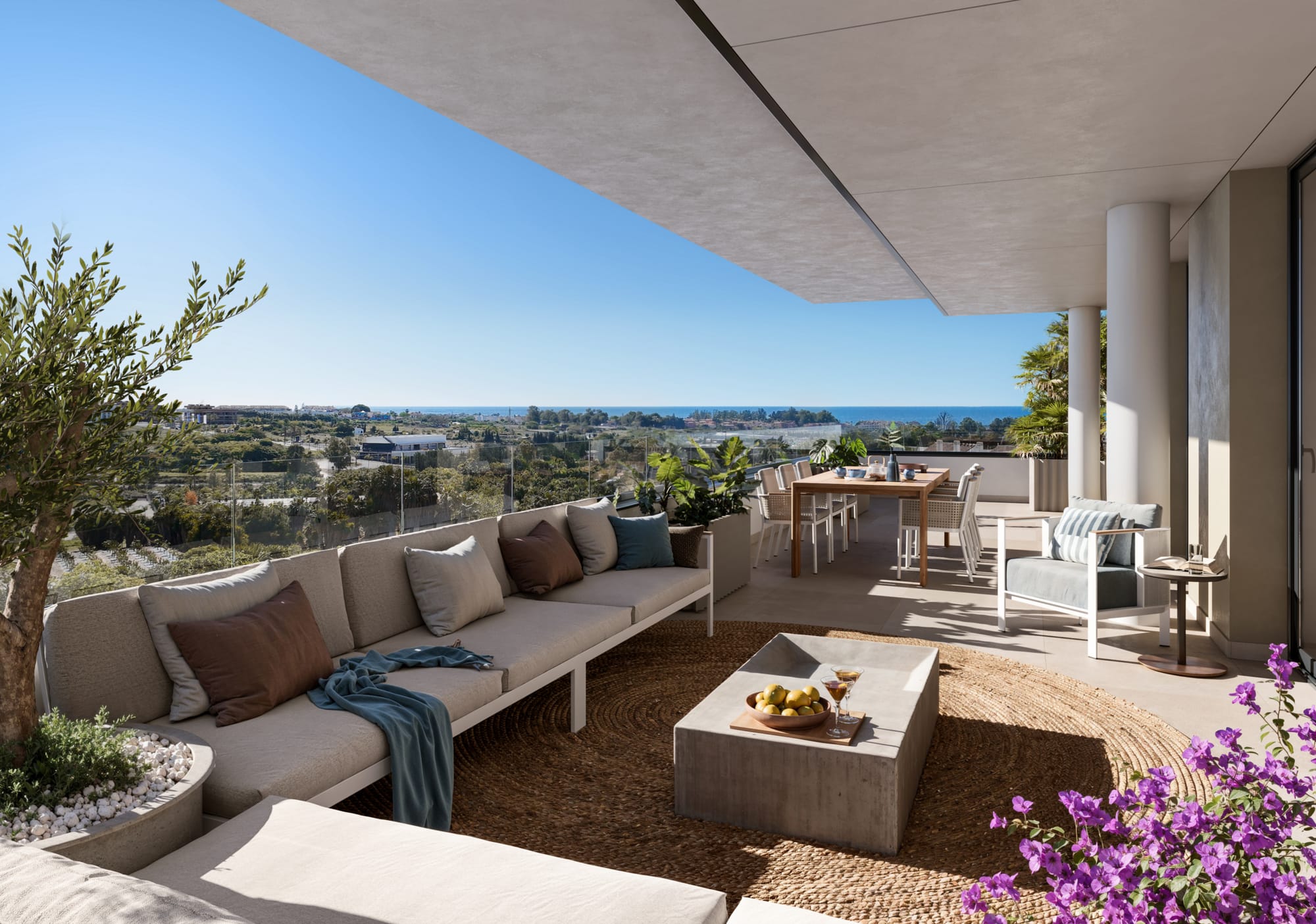
This guide is for international owners with a new holiday or second home on the Costa del Sol. You will learn what it really costs to own your home each year, with clear, real numbers. We use a 500.000 euros new-build apartment so you can plan with confidence.
At a glance: Buying is one cost. Running your home every year is another. For a typical 500.000 euros new-build apartment on the Costa del Sol, budget roughly 5.000 to 7.500 euros a year, or about 450 to 625 euros a month. The biggest item by far is the community fee, then utilities, then the two yearly taxes (IBI and IRNR). A simple complex costs less, and a villa with a private pool and garden costs more, often 8.000 to 12.000 euros a year.
Headline yearly numbers for a standard 500.000 euros new-build apartment:
- ~3.000 euros - community fees (resort-style complex)
- ~1.500 euros - utilities (used part of the year)
- ~1.870 euros - taxes, rubbish and insurance
- ~530 euros - per month all-in, before optional management
Most buyers plan for the purchase and forget these yearly costs. That is the mistake. Below we break down every euro, with the real figures we see on the Costa del Sol in 2026.
The two types of running cost
It helps to split your yearly costs into two groups:
- Fixed costs: you pay these even if the home sits empty. Taxes, community fees, insurance, and basic upkeep.
- Variable costs: these depend on how much you use the home. Electricity, water, gas, and internet.
For a holiday home you visit a few times a year, fixed costs make up most of the bill. The lights and water are off most of the time, but the community fee and taxes never stop.
Bonus tip: Plan for the fixed costs first. They are the real base of your yearly budget, and they do not change whether you visit once a year or twelve times.
Community fees: usually your biggest cost
For a new development with shared areas, you pay community fees (gastos de comunidad) - your share of running the complex.
What they cover:
- Pool or pools, gardens and lifts
- Gym, spa and other facilities
- Cleaning and lighting of shared areas
- Security and gated access
- Insurance of the shared parts of the building
The amount depends on the facilities, not on what you paid for the home. The more resort-style the complex, the higher the fee. A rough guide, per month:
- Simple older block: 80 to 150 euros
- Standard new-build (Mijas, Estepona, La Cala): 150 to 250 euros
- Resort-style new-build with pool, gym, spa and concierge: 250 to 350 euros
- Marbella premium: 300 to 600 euros
Worked example, our reference new-build: about 250 euros a month, which is 3.000 euros a year. A larger or more luxurious complex runs 300 euros a month or more.
Warning: A pool, gym, spa and 24-hour security feel great, but they raise your monthly fee for life. You pay your share even if you never use them. Check the exact community fee before you buy, not after.
IBI: the local council tax
IBI (Impuesto sobre Bienes Inmuebles) is the yearly local property tax, like council tax in the UK. You pay it once a year to the town hall.
It is based on the cadastral value (an official value, much lower than the market price), not on what you paid. The rate is about 0,4% to 1,1% of that value. For a new-build, the first IBI bill only arrives after completion, once the home is on the cadastre.
Worked example on a 500.000 euros apartment: about 900 euros a year (typical range 800 to 1.100 euros).
Bonus tip: Set up a direct debit for IBI from your Spanish bank account. Deadlines change from town to town. Direct debit means you never miss it and never pay a fine.
IRNR: the tax on owning, even when empty
This is the cost that surprises almost every foreign owner. IRNR (non-resident imputed income tax) is a small yearly tax you pay just for owning a home you do not rent out. Spain treats the right to use your home as a kind of income and taxes it.
How it works:
- The tax office assumes an "income" of 1,1% of the cadastral value. The cadastral value is often around 40% of the price you paid.
- You pay 19% on that as an EU or EEA owner, or 24% as a non-EU owner - and that includes British owners since Brexit.
Worked example on a 500.000 euros apartment (cadastral value about 200.000 euros):
- 2.200 euros - assumed income (200.000 euros x 1,1%)
- EU/EEA owner at 19%: about 418 euros a year
- Non-EU owner (incl. UK) at 24%: about 528 euros a year
You file it once a year on the form Modelo 210. If you rent the home out, you pay tax on the real rent for those days instead, and this imputed tax falls - it drops to zero if the home is rented out all year.
Warning: When you sell, the tax office checks you paid IRNR every year you owned the home. Skipping it now causes problems later. Pay it each year, or have a tax adviser do it for you.
Rubbish tax (basura)
The rubbish collection charge (basura) is usually a separate small bill from the town hall, not part of IBI.
- Typical cost: 100 to 250 euros a year, depending on the municipality (Estepona, Marbella and Mijas each set their own rate).
Worked example: about 150 euros a year.
It is easy to forget because it arrives separately. Add it to your budget so it does not surprise you.
Utilities: electricity, water, internet
This is your main variable cost. It depends on how often you are in the home and how much heating and air conditioning you use.
When the home is actively lived in, budget about 170 to 300 euros a month all-in for electricity, water and internet. When it sits empty, you pay only the standing charges (a fixed connection fee), roughly 60 euros a year each for power and water.
Worked example on a 500.000 euros home used part of the year: about 1.500 euros a year. Live in it most of the year and it is higher; a few weeks only and it is lower.
Bonus tip: New-builds with aerothermia (an aerothermal heat-pump for heating and hot water) run noticeably cheaper than older gas or electric-only homes. Good insulation and modern systems are a real saving over the life of the home, and one more reason a new development costs less to run than a resale.
Home insurance
You are not required by law to insure your home unless you have a mortgage, in which case the bank will insist on building cover. Even without one, insurance is strongly advised.
- Typical cost: 300 to 800 euros a year, depending on whether you include the contents and furniture.
There are two main covers: building insurance (the structure) and contents insurance (your belongings). Most owners take both.
Worked example: about 400 euros a year.
Looking after the home, and renting it out
If you live abroad and the home sits empty for months, someone should check on it. A leak found early saves a lot of money.
- A keyholder or property manager to check the home, air it, and handle small jobs costs about 100 euros a month.
If you decide to rent it out, management is charged as a share of the rent, not a flat fee:
- Short-term (holiday lets): about 18% to 25% of the rental income.
- Long-term: about 8% to 12% (often just one month's rent as the finding fee).
This is optional. For a home you visit a few times a year a manager is wise, but in a good complex the on-site staff and neighbours can cover it for free. Ask before you buy.
Wealth tax: usually not a worry
Spain has a wealth tax (Impuesto sobre el Patrimonio), but for most owners it does not apply. There is a large tax-free allowance, and it only bites if your total Spanish assets run into the millions (broadly around 3 million euros and up, depending on the region). A single 500.000 euros holiday home is well below that line. We flag it only so you know it exists and can stop worrying about it.
The derrama: the surprise charge to watch
Here is the one extra cost that catches buyers off guard: the derrama.
A derrama is a special one-off charge from the community for a big repair, like a new lift, a new roof, or repainting the building. It is shared among all owners and can be hundreds or even thousands of euros, with little warning. New developments rarely face one in the early years, but it matters a lot in older blocks.
You can protect yourself. Before you buy, your lawyer should read the recent community meeting notes. They show any planned big works and any debts. If a 10.000 euros job is coming, you want to know before you sign, not after.
At Spain Developments, we are an independent buyer's agent paid by the developer, so you pay us no fee. We always make the running costs and any community issues clear before you buy. No nasty surprises is our whole point.
The full yearly cost on a 500.000 euros new-build
Here is the complete yearly running cost for a standard 500.000 euros new-build apartment, used by a non-resident part of the year.
- 3.000 euros - community fees (resort-style complex)
- 900 euros - IBI council tax
- 418 euros - IRNR non-resident tax (EU owner; about 528 for non-EU)
- 150 euros - rubbish tax
- 1.500 euros - utilities (part-year use)
- 400 euros - home insurance
- Subtotal: about 6.370 euros a year (~530 a month)
- Optional keyholder or property manager: about 1.200 euros a year
- All-in with management: about 7.570 euros a year (~630 a month)
A simpler complex with a lower community fee, plus light use, can bring this under 5.000 euros a year. As a rule of thumb, budget 1% to 1,5% of the home's value a year for running costs, plus a little extra for one-off repairs. For 500.000 euros that is 5.000 to 7.500 euros, which matches the breakdown above.
Note: This is for an apartment. A villa with a private pool and garden costs more, mostly from pool care, gardening and higher utility use.
And when you sell
Two taxes apply when you sell, on top of your agent and lawyer fees:
- Capital gains tax (CGT) on the profit: 19% for EU/EEA sellers, 24% for non-EU sellers. You are taxed on the gain, not the whole sale price.
- Plusvalía municipal: a local town-hall tax on the rise in the cadastral land value during your ownership. How it is worked out depends on how long you held the home, and your lawyer calculates it.
You can reduce the gain (and so the CGT) with allowable costs, so keep every invoice:
- What you paid, plus the purchase taxes and fees (IVA or ITP, notary, registry, lawyer).
- Capital improvements with proper invoices - a new kitchen, air conditioning, adding a pool.
- Sale costs - agent commission, lawyer, the energy certificate, and the plusvalía you paid.
Bonus tip: If you are a non-resident seller, the buyer holds back 3% of the price and pays it to the tax office against your CGT. If your real CGT is lower, you claim the difference back on Modelo 210. Keep your improvement invoices from day one - they turn into money back at the end. We cover the sale taxes in full in our guide to property taxes for non-residents.
Apartment vs villa: a quick compare
Many buyers ask whether a villa costs much more to run. The short answer is yes, mostly because of the pool and garden.
Standard new-build apartment
- Community fees: about 3.000 euros
- Pool and garden: included in the community fee
- Utilities: about 1.500 euros
- Taxes, rubbish and insurance: about 1.870 euros
- Total: about 6.400 euros a year
Villa with private pool and garden
- Community fees (if in an urbanisation): 500 to 1.500 euros
- Pool care: 600 to 1.400 euros
- Gardening: 1.000 to 3.000 euros
- Utilities: 2.500 to 4.000 euros
- Taxes and insurance: 1.500 to 3.000 euros
- Total: about 8.000 to 12.000 euros a year
So a villa can cost nearly double an apartment to run. If low running costs matter to you, an apartment in a well-run new complex is usually the easier choice.
Conclusion
The yearly cost of owning a standard 500.000 euros new-build apartment on the Costa del Sol is about 5.000 to 7.500 euros, or roughly 450 to 625 euros a month. The biggest items are the community fee and utilities, with IBI and IRNR as the main yearly taxes, and CGT and plusvalía when you sell. Villas cost more, mainly the pool and garden. Plan for these from the start, watch out for the derrama, and your Spanish home stays a joy, not a worry.
Want the exact running costs for a specific home you have seen? Get in touch with Spain Developments and we will work them out for you, with no fee and full transparency.
Written by
Samuel Sprenar